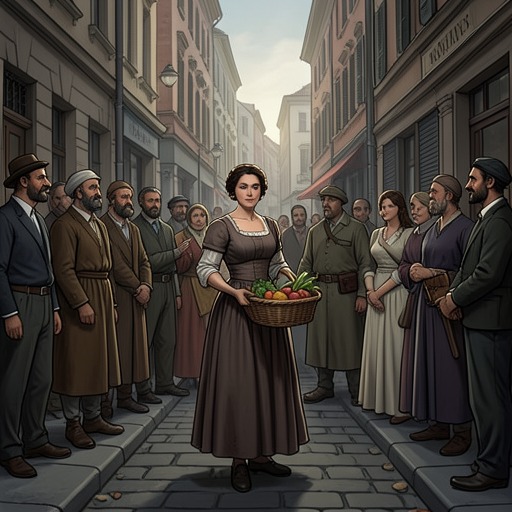
Town Street
A Woman of SubstanceTown Street is the Armley shopping thoroughfare on which Emma Harte finds the first practical foothold for her ambition to build a fortune. What begins as a promising stretch of shops becomes the site of her first store and, as her business expands, a visible measure of her transformation from a working-class outsider into a determined retailer.
Setting and commercial character
As Emma and Blackie O’Neill walk through Armley, Town Street appears not as an abstract business opportunity but as a functioning shopping district. Its shops include a fishmonger, a haberdasher, a chemist, and an established dress shop for well-to-do customers. The row continues toward Branch Road, suggesting a substantial commercial stretch rather than an isolated storefront. Nearby, neat houses with green doors, gardens, and iron gates give the district a settled, respectable character.
The first view of the street also carries a private ache for Emma. Snow and ice make its ordinary houses seem festive and inviting; through lit windows she imagines families gathered warmly together, and longs for her father and Frank. Yet the sight of the shops quickly redirects her attention from the home she misses to the future she might make. Town Street offers a commercial possibility within reach of Armley, rather than requiring her to begin in Leeds: she reasons that rents may be lower and that she can court the carriage trade, where she believes the money lies.
Emma’s first shop
The possibility becomes concrete when Emma sees a vacant shop in a block of three adjoining premises fronting Town Street. A small clear space in the whitewashed window displays a to-let notice, with the landlord’s name, Joe Lowther, and address beneath it. Emma memorizes the details and decides to apply first, even though it is Sunday and business is not usually conducted that day. The empty window changes the street from a place she has surveyed into an immediate opportunity she intends to claim.
Emma goes directly to Joe, prepared to act quickly and to negotiate on her own behalf. The premises become her first shop, giving physical form to an ambition previously sustained by planning and hard work. The importance of the location lies partly in its scale: she is not starting with an imagined chain or a grand establishment, but with one available unit in a row of neighboring shops. Town Street makes expansion imaginable because it offers both a customer base and adjacent premises.
Expansion and retail practice
The three-shop block supplies the outline of Emma’s larger commercial vision. Joe understands that she has been angling for the third shop, and recognizes how three adjoining premises could become the department store she hopes one day to own. The street therefore serves not only as the address of her beginning but as the setting for a plan of growth, in which neighboring units can be gathered into a larger enterprise.
Her retail work is shown through the exacting care she gives to a food shop’s Christmas display. On a December morning, Emma has been up since half past four arranging glass cabinets and removing even a particle of dust. The seasonal stock includes almond-topped cakes, plum puddings tied in red ribbon, mince pies, and chocolate-coated yule logs. She also sets out imported delicacies unavailable elsewhere in Armley, among them crystallized ginger, French glazed fruits, Turkish delight, Egyptian dates, Greek figs, and German marzipan. The display combines disciplined presentation with a deliberate effort to distinguish her shop from its local competitors; Emma expects the festive stock, including additional supplies kept in the cellar, to sell briskly.
Narrative significance
Town Street marks the point where Emma’s resolve acquires a commercial address. Its existing shops show her the trade already serving the neighborhood, while the vacant premises let her convert observation into action. Her attention to rent, customer class, neighboring units, stock, and presentation makes ambition concrete: success is built through decisions about where to trade and how to make a shop worth entering.
The location also holds together the vulnerability and confidence of Emma’s early years in Armley. The warmly imagined homes remind her of the family life she has left behind; the shop windows, by contrast, invite her to construct security through work. As she moves from spotting one vacancy to envisioning three adjoining shops and a department store, Town Street becomes a measure of progress achieved on a scale she can seize for herself.